Post

NORMAN KNIGHTS in CALABRIA

Immagine
Short Story -  The Normans descended from Vikings, was a north European people and knowed as skilled navigators, left their land in search of fortune and booty. To the early IX century A.D. from Scandinavia they arrived and looted the Britannic Islands, also creating communities, sequentely between IX-X century they settled in the north of France, precisely in Normandy.    HISTORY IN ITALY - The first Normans in Italy were a group of military knights and adventurers, arrived in the early XI century a.C. and were guided by Drengot brothers (Osmond, Gibert and Rainulf), in some cases they offered protection under payment to the pilgrims who to reached the sanctuary of San Michele sul Gargano (Puglia). Sanctuary of San Michele Sanctuary of St Michele sul Gargano seen from above (foto by Matteo Nuziello) Shortily afterwards (1018) they were at the side of Melo of Bari (important rich longobard) to fight the Byzantine from Puglia, but the battle fini...
POSEIDONIA/PAESTUM

Immagine
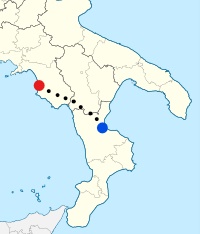
Cari lettori, in questo post narrerò la nascita di una sub-colonia greca fondata dalla ricca polis calabrese di Sybaris . Accenni storici - I Greci della ricca  polis  di Sibari  per avere uno sbocco commerciale sul mar Tirreno e quindi non intraprendere il periplo della Calabria, fondarono nel VII secolo a.C. diverse sub-colonie sulla costa tirrenica, tra cui Poseidonia . I Sibariti dedicarono la città a Poseidone, fondandola al centro della fertile piana del Sele, territorio che contribuì notevolmente alla sua crescita, quindi prosperò e divenne centro più importante dell'area del basso Tirreno tra Campania, Basilicata e Calabria. Nel 510 a.C. Sibari fu distrutta dai Crotone così molti cittadini Sibariti si rifugiarono a Poseidonia, in questo periodo si riscontra l'acme della floridezza della città. in blu SIBARI e in rosso POSEIDONIA (Paestum) veduta di Paestum dall'alto immersa nella fertile piana del Sele, sullo sfondo il mar Tirreno prospettiva d...

COSENZA BRETTIA E ROMANA

Immagine
Cari lettori, facciamo un salto nella città calabrese che possiede uno dei centri storici più grandi d'Italia: Cosenza è una delle più antiche città italiane, la sua area fu abitata almeno dall'VIII secolo a.C. da popoli Italici con un villaggio di nome Kossa , nel V secolo a.C. fu occupata dalla tribù autoctona dei Bruzi  con il nome di Cossa , eleggendola a loro capitale. ETA' BRUZIA - I Bruzi la occuparono perché capirono l'importanza strategica del suo sito, al centro di una valle passaggio obbligato per raggiungere altre sub-regioni calabresi, e all'incrocio dei fiumi Crati e Busento che le garantivano contatti verso le due coste (tirrenica e ionica). Molto probabilmente il primo nucleo della città fu ubicato sulla sommità del colle San Pancrazio, nonché quello più altro fra i colli che cingono Cosenza, proprio da qui gli abitanti controllavano il territorio circostante ed erano più sicuri in caso di attacchi. Purtroppo al giorno d'oggi non abbiamo mo...

MEDIEVAL ROUTES in CALABRIA

Immagine
The ports and terrestrial viability were indispensable for the economy of the Roman Empire, above all in late ancient age (III-IV century A.D.) to export the agricultural productions of the rural territory. In the Late Ancient (II-III-IV centuries a.C.) the landscape of Calabria was dotted with roman productive villas , especially in the coastal areas of the Region, some of them survived until the VI century a.C.. This system of villas was located near important roman cities , to sell the agricultural and artisanal products in these cities markets , related at large coastal arterias ( pubblicae ) and near at rispective ports , for export of goods to other parts of the Mediterranea sea. points in red: known roman villas scattered in the coastal agricultural areas. On these roads and near villas were built great termae  (thermal environments), it were places of socialization and decisions of development of the areas, but also activies among influential local nobles/sen...